
Olivier Mosset
Effacement
June 6 - July 4 2026
Erasure
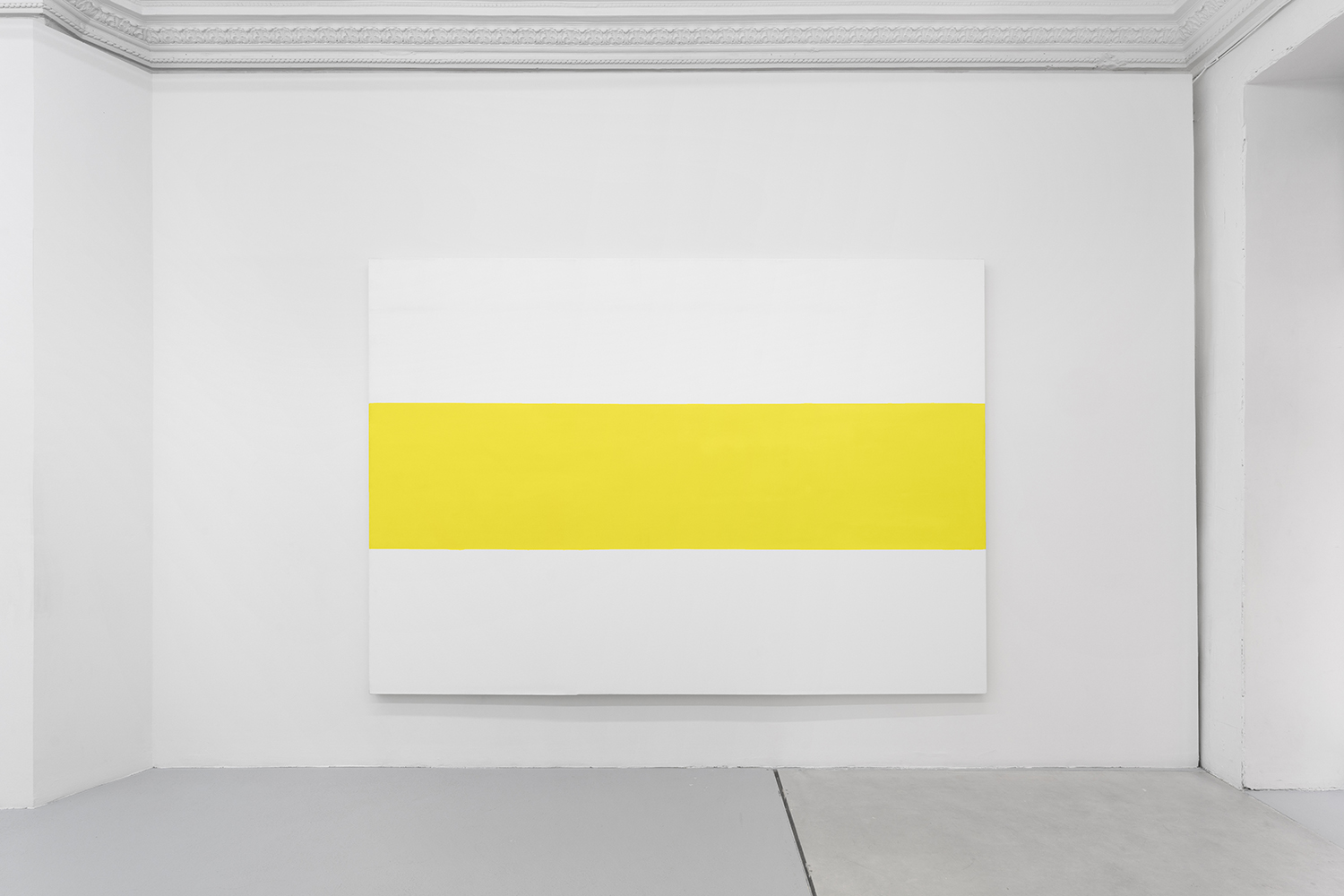
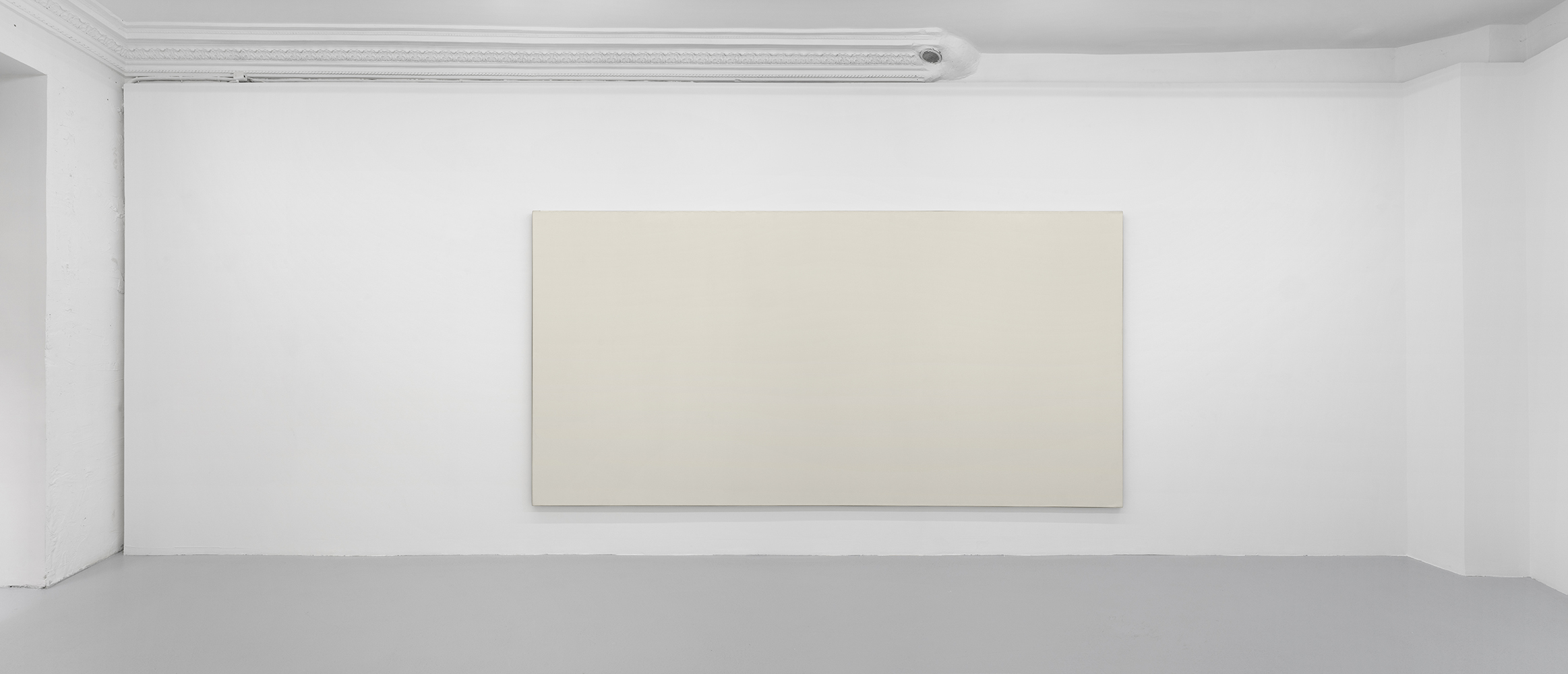
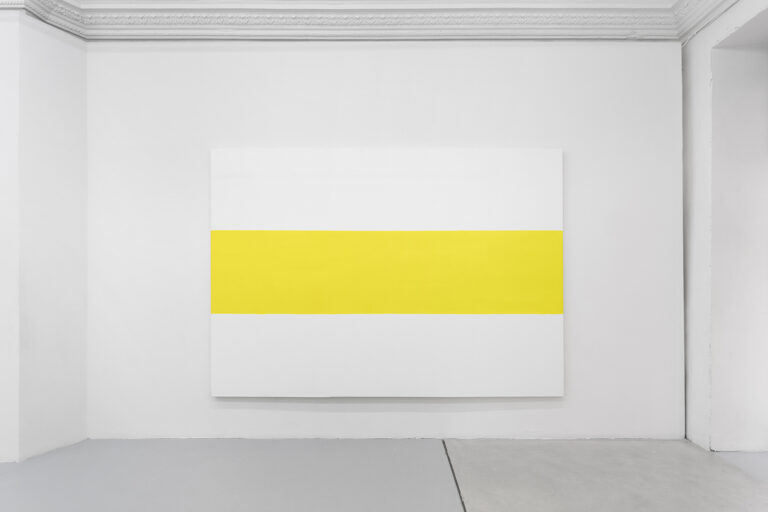
Olivier Mosset — Yellow stripe, 1989 / Swiss Coffee, 2002
There is in Olivier Mosset’s work a way of withdrawing from painting almost everything that traditionally serves as its alibi: image, composition, expression, gesture, narrative, virtuosity. This withdrawal acts as a form of precision. The less the painting seems to want to say, the more decisive each remaining element becomes: a surface, a color, a format, a title, a presence on the wall.
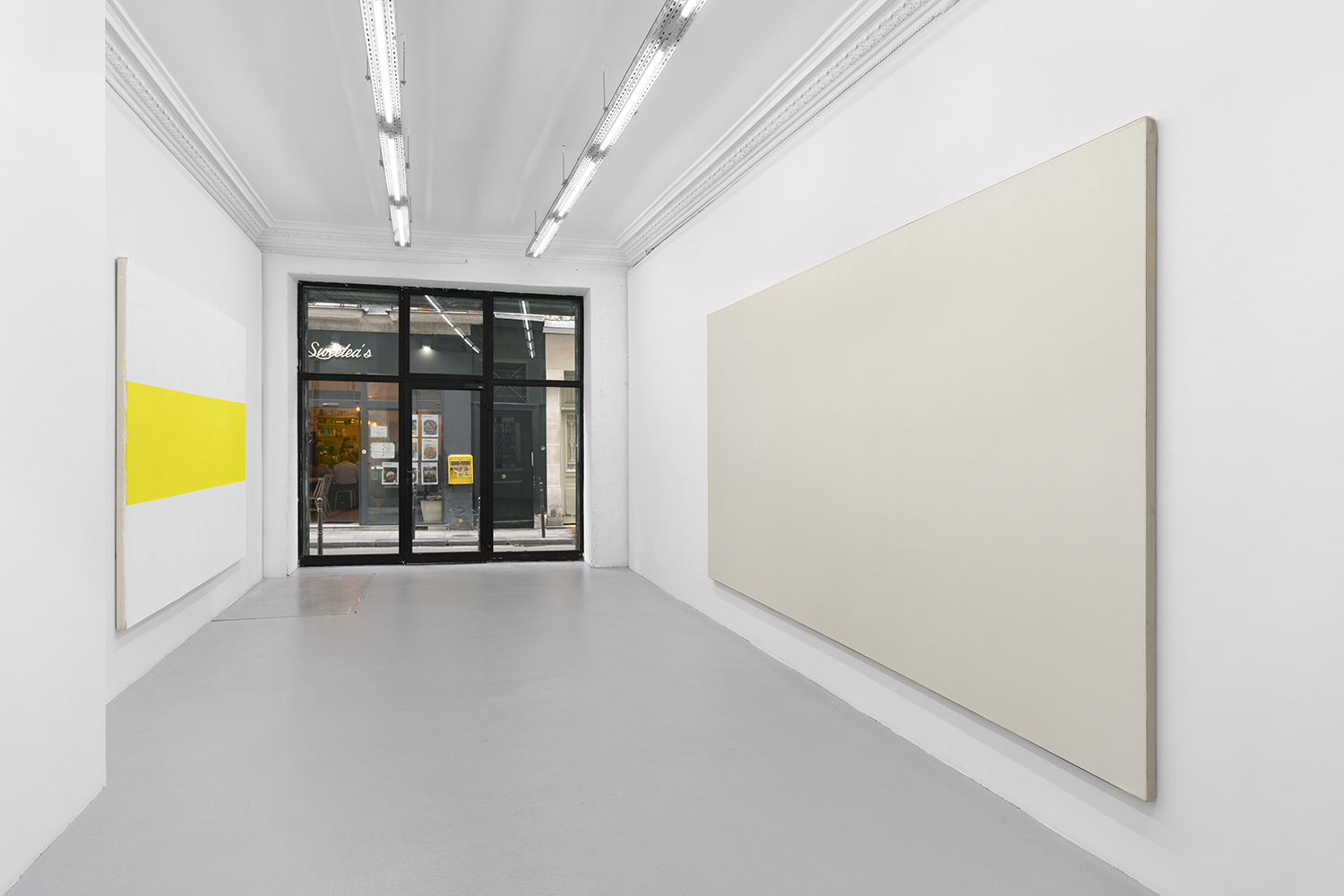
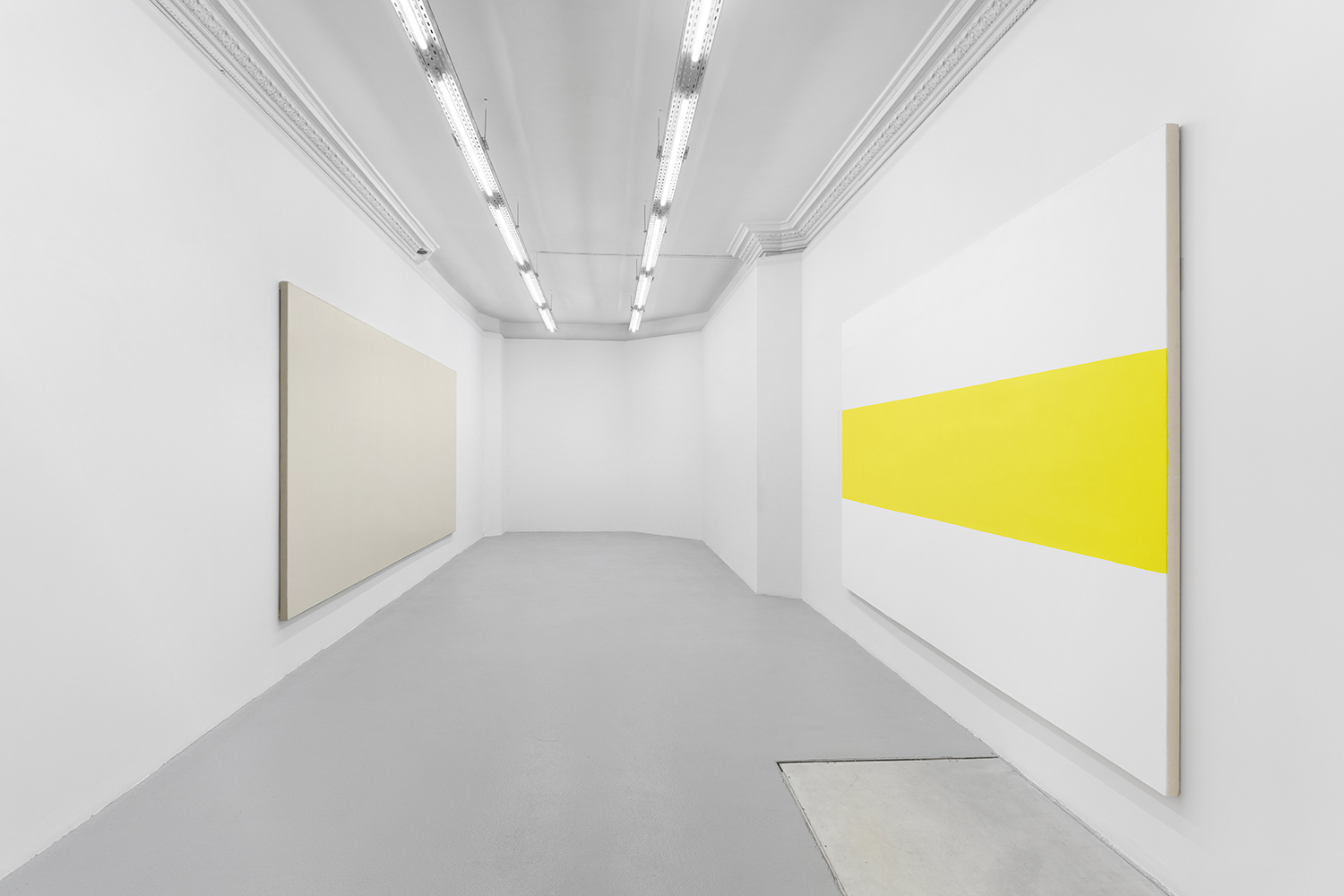
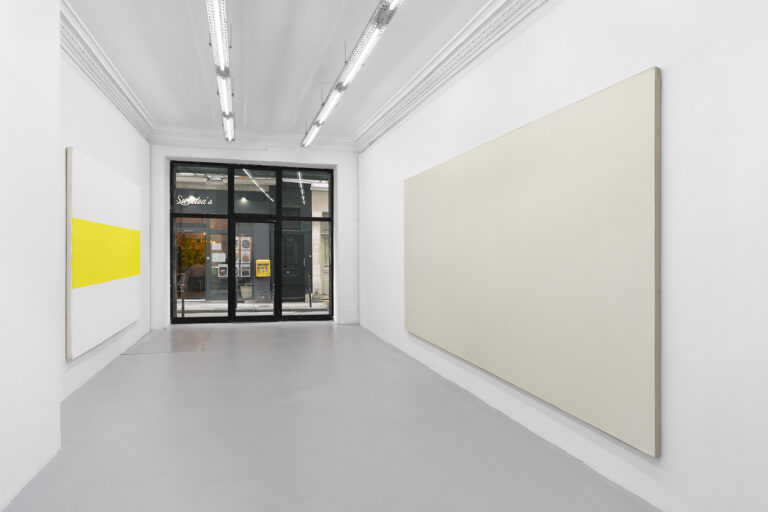
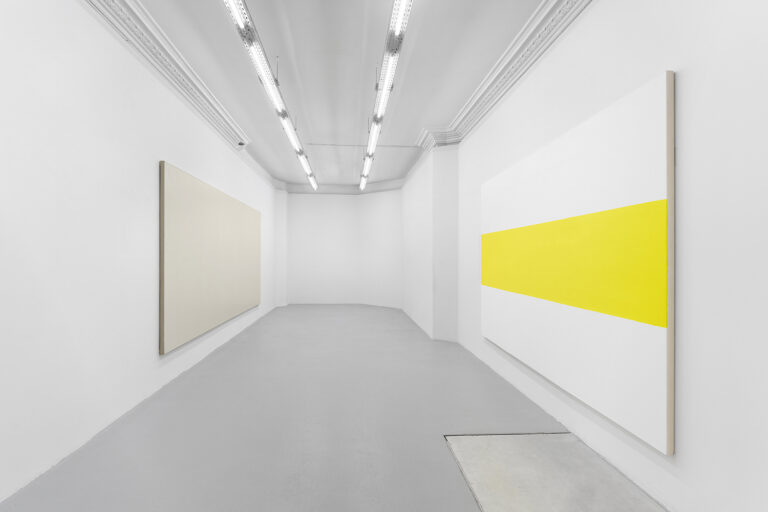
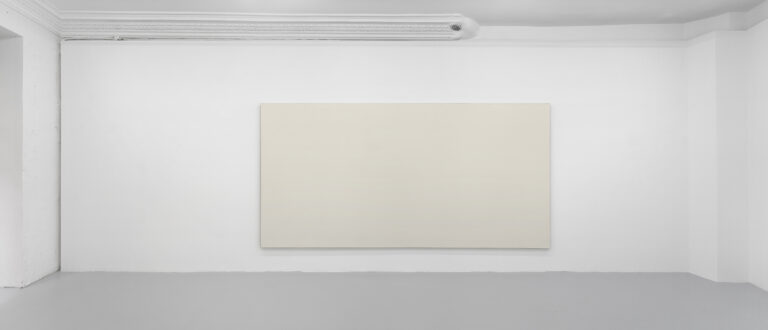
The exhibition brings together two monumental paintings hung face to face. On the right, Yellow stripe, 1989: a white field crossed by a broad horizontal yellow band. On the left, Swiss Coffee, 2002: a white monochrome more than four meters long. The two canvases share the same height, 213 centimeters. The face-to-face is calibrated. On one side, a mark still visible; on the other, at the same scale, its near-complete absorption.
In Yellow stripe, the yellow still holds a sign. It occupies nearly a third of the canvas, edge to edge: less a line than a field within the field. It cuts the canvas, imposes a measure. But it refers to nothing outside itself. Neither symbol, nor horizon, nor motif. A color laid down without drawing, without gesture. The painting does not compose. It states.
With Swiss Coffee, Mosset removes this last mark. The painting seems to want to join the wall, to be absorbed into it. But the disappearance remains incomplete, and that is where the work stands. The white of the canvas is not that of the wall: warmer, faintly cream against the cool white of the surrounding surface. A thickness, an edge, a stretcher. The eye encounters almost nothing, but this almost nothing is enough to make the painting appear as an object.
The title completes this displacement. Swiss Coffee belongs to the vocabulary of the paint chart: an off-white of house paint, coded, commercial. The painting bears this name and seems to dwell in this color: it is the color that keeps it from merging entirely with the wall. The title forbids the monochrome to present itself as an absolute, a metaphysical silence, a modernist purity. This white belongs to language and to use. The canvas becomes at once a painted thing and the designation of that thing, a physical object and a mental proposition.
It is in this sense that this painting is deeply conceptual: it thinks through its own means. Mosset questions what a painting is from inside the painting. He needs only to reduce it, to hold it at the limit of its own erasure, to the point where the smallest remaining element becomes active. The wall itself enters the work as a condition of reading.
Erasure names an operation: removing everything that blurs, everything that seduces too quickly, everything that turns the painting into image or spectacle. Mosset reduces painting to increase its exactness. What remains is a painting brought back to its facts: a surface, a color, a format, a name.
Effacement
Olivier Mosset — Yellow stripe, 1989 / Swiss Coffee, 2002
Il y a chez Olivier Mosset une manière de retirer à la peinture presque tout ce qui, traditionnellement, lui sert d’alibi: l’image, la composition, l’expression, le geste, le récit, la virtuosité. Ce retrait agit comme une forme de précision. Moins la peinture semble vouloir dire, plus chaque élément qui demeure devient décisif : une surface, une couleur, un format, un titre, une présence au mur.
L’exposition réunit deux tableaux monumentaux placés face à face. À droite, Yellow stripe, 1989 : un champ blanc traversé par une large bande jaune horizontale. À gauche, Swiss Coffee, 2002 : un monochrome blanc de plus de quatre mètres de long. Les deux toiles ont la même hauteur, 213 centimètres. Le face-à-face est calibré. D’un côté, une marque encore visible ; de l’autre, à la même échelle, son absorption presque complète.
Dans Yellow stripe, le jaune maintient encore un signe. Il occupe près d’un tiers de la toile, bord à bord : moins une ligne qu’un champ dans le champ. Il coupe la toile, impose une mesure. Mais il ne renvoie à rien d’extérieur à lui-même. Ni symbole, ni horizon, ni motif. Une couleur posée sans tracé, sans geste. Le tableau ne compose pas. Il constate.
Avec Swiss Coffee, Mosset retire cette dernière marque. Le tableau semble vouloir rejoindre le mur, s’y absorber. Mais la disparition reste incomplète, et c’est là que l’oeuvre se tient. Le blanc de la toile n’est pas celui du mur : plus chaud, légèrement crème contre le blanc froid de la cimaise. Une épaisseur, un bord, un châssis. Le regard ne rencontre presque rien, mais ce presque rien suffit à faire apparaître la peinture comme objet.
Le titre achève ce déplacement. Swiss Coffee appartient au vocabulaire du nuancier : un blanc cassé de peinture murale, codé, commercial. Le tableau porte ce nom et semble se tenir dans cette couleur : c’est elle qui l’empêche de se fondre entièrement dans le mur. Le titre interdit au monochrome de se donner comme un absolu, un silence métaphysique, une pureté moderniste. Ce blanc appartient au langage et à l’usage. La toile devient à la fois une chose peinte et la désignation de cette chose, un objet physique et une proposition mentale.
C’est en ce sens que cette peinture est profondément conceptuelle : elle pense à travers ses propres moyens. Mosset interroge ce qu’est un tableau depuis l’intérieur du tableau. Il lui suffit de le réduire, de le maintenir à la limite de son propre effacement, jusqu’au point où le moindre élément restant devient actif. Le mur lui-même entre dans l’oeuvre comme une condition de lecture. Effacement nomme une opération : enlever tout ce qui brouille, tout ce qui séduit trop vite, tout ce qui transforme le tableau en image ou en spectacle. Mosset réduit la peinture pour en augmenter l’exactitude. Demeure une peinture ramenée à ses faits : une surface, une couleur, un format, un nom.